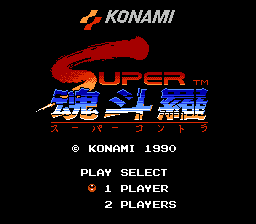
Play Super Contra (Japan)
Game Introduction
Super Contra is a side-scrolling action shooter arcade game released by Japan’s Konami in 1988, serving as the sequel to the classic *Contra*. It was ported to the NES in 1990 and became a beloved classic among players. The game retains the core system of its predecessor while introducing improvements and innovations. First, the weapon system has been revised: weapons previously represented by red falcons now use gun icons, and some weapon forms have changed. For example, the Flame Gun (F) now fires spreading large fireballs instead of rotating small ones. Additionally, the game removes the pseudo-3D overhead stages from the first title, replacing them with top-down stages where players can move and shoot in eight directions. In these stages, players can collect bomb items that instantly eliminate all on-screen enemies—a feature later adopted in the SFC version. Notably more difficult than its predecessor, *Super Contra* is widely regarded as one of the most challenging entries in the *Contra* series. Set one year after the events of the original *Contra*, the story takes place in December 2634 A.D. The 7th Division of the Earth Federation’s South American GX Army sends a distress signal during a military exercise. The Federation concludes that the remnants of the "Red Falcon" and aliens are responsible, and dispatches *Contra* team members Bill Rizer and Lance Bean on a mission to destroy the enemy base. The NES port features several adjustments. The Japanese version is titled *Super Contra* (dropping the arcade’s subtitle "The Alien Strikes Back"), while the U.S. version is called *Super C*. Compared to the arcade release, the NES version is significantly easier: weapon icons revert to falcons (flashing red and blue instead of solid red) and lose their level-up system. Bombs in top-down stages are replaced by unmarked falcons that clear all on-screen enemies when collected. The NES version also adds new stages but removes the arcade’s fourth level, adjusting the overall progression. With its innovative design and high difficulty, *Super Contra* has become a classic action shooter, cherished by players worldwide.
Gameplay
Game Overview
Super Contra began as Konami's 1988 arcade sequel and reached the Famicom in Japan on February 2, 1990, then North America in April under the name Super C, changed to avoid the Iran-Contra association. The console version keeps the systems of the first NES Contra but drops the fake-3D into-the-screen stages for top-down levels with eight-way movement and firing. Difficulty was tuned well below the arcade, the arcade's fourth stage was cut, and three stages were built specifically for the console: a high-tech base, a mountain, and an alien nest.
Core Gameplay
Side-view stages let you duck, jump and tumble, with weapons dropped from flying falcon capsules: S for spread, F for fire, L for laser, R for rapid fire, plus barrier and special pickups. The Famicom version restores the falcon icon instead of the arcade's gun icons, flashing red and blue, and drops weapon levelling entirely. The fire weapon now lobs a large projectile that bursts on impact, and holding B before releasing fires a bigger shot that punches through most fodder. Top-down stages give you eight-way aiming and a screen-clearing pickup.
How the Famicom Version Differs from Super C
This Japanese release keeps a stage select code and a thirty-life cheat; Super C only offers a ten-life code and the stage select was stripped out. The title differs too: the Japanese cart is simply Super Contra, dropping the arcade subtitle, and its intro text is Japanese, dating the mission to December 2634, one year after the first game. Both versions include a sound test. Bill Rizer and Lance Bean are sent back out to destroy the base of the Red Falcon remnants and their alien allies.
Game Tips
- Japanese-only stage select code, plus a thirty-life cheat where Super C only gives ten
- Weapons drop from falcon capsules: S spread, F fire, L laser, R rapid fire, plus barrier
- The fire weapon lobs a bursting fireball, and holding B charges a shot that punches through crowds
- Fake-3D stages replaced by top-down levels with eight-way movement and aiming
- Three stages built for the console version: high-tech base, mountain, alien nest
- Simultaneous two-player co-op with shared screen and continues
- Built-in sound test for every music track and effect in the game
Frequently Asked Questions
Tough for the series, though the Famicom version was toned down considerably from the 1988 arcade. One hit still kills and you lose your weapon, you start with three lives, and progress mostly comes from memorising spawn points.
No battery save and no password, so it is a one-sitting clear. The Japanese version does let you start from later stages with its stage select code, which the Western Super C lacks.
Stage layout and difficulty are essentially the same. The differences are cheats and text: thirty lives and stage select here versus ten lives and no stage select in Super C, plus a Japanese intro sequence that keeps the 2634 dating and drops the arcade subtitle.
No. The story picks up a year later but the mechanics are close to identical, so starting here costs you nothing.
About twenty minutes for a clean one-credit run. With cheats and generous continues, a newcomer will spend an hour or so. The real investment is learning the stages, not the running time.