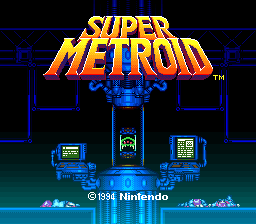
Play Super Metroid (USA, Europe) (En,Ja) (Virtual Console, Classic Mini, Switch Online)
Game Introduction
Super Metroid is a 2D side-scrolling action-adventure game co-developed by Nintendo R&D1 and Intelligent Systems, released for the Super Nintendo Entertainment System in 1994. Players control bounty hunter Samus Aran, who travels to the fictional planet Zebes to retrieve a stolen Metroid larva from space pirate leader Ridley. Known for its open-world design and deep exploration elements, the game requires players to collect various abilities and weapons to unlock new areas and defeat powerful enemies. Praised for its atmosphere, gameplay, sound, and graphics, it is regarded as one of the best games of its era. While it had modest sales in Japan, it succeeded in North America and Europe. Its design influenced many later titles and laid the foundation for the Metroidvania genre.
Gameplay
Game Overview
Super Metroid was co-developed by Nintendo R&D1 and Intelligent Systems under director Yoshio Sakamoto, released in Japan on March 19, 1994, in North America on April 18 and in PAL regions on July 28. Bounty hunter Samus Aran returns to planet Zebes to take back a Metroid larva stolen by Ridley, leader of the Space Pirates. It had shipped 1.42 million copies worldwide by late 2003, selling modestly at home but strongly in North America and Europe.
Core Gameplay
Zebes is one connected mass of Crateria, Brinstar, Norfair, the Wrecked Ship, Maridia and Tourian, stitched together by doors and elevators, and progress means picking up the upgrade that opens a door you walked past an hour earlier. Samus fires in eight directions, charges her arm cannon and can keep firing while backing away via the Moon Walk. The Morph Ball rolls into tunnels and lays bombs, the Speed Booster charges into a Shinespark, and wall jumping, Space Jump, the Grapple Beam, the X-ray Scope and the Screw Attack open the map layer by layer. The automap, the inventory screen and Reserve Tanks all debut here.
Abilities and Sequence Breaking
Experienced players bomb-jump instead of waiting for the Spring Ball and use wall jumps and Shinesparks to reach late-game rooms early, the sequence breaking that turned this into a speedrunning staple. Three endings depend on your finishing time, and beating the game in under three hours reveals the best one, in which Samus is shown out of her suit. Saving is only possible at save stations and aboard Samus's own ship, which also refills health and ammunition.
Game Tips
- Morph Ball and Bombs: bomb jumping replaces the Spring Ball in several climbs and is the first technique every speedrunner learns
- Shinespark: charge up with the Speed Booster, then release vertically or horizontally to smash through hidden paths
- Eight-direction aiming plus the Moon Walk, which lets Samus fire or charge while backing away instead of standing still
- Automap and map computers, new to the series, each room's computer revealing the parts of the region you have not visited
- Reserve Tanks bank spare energy and top you up automatically when your health runs out, and can be toggled in the inventory
- Three endings decided by completion time, with the best one showing Samus out of her power suit
- Saves only at save stations or the gunship, which also restores health and ammunition
Frequently Asked Questions
Exploring without a guide runs eight to ten hours. Once you know the map, a 100% item run takes four to six hours, and speedrun routes finish in under an hour.
Far more than the original: there is an automap, frequent save stations and a gently guided opening. There are no quest markers though, so when you get stuck visit the region's map computer to reveal unexplored rooms.
Only at save stations scattered around Zebes or aboard Samus's ship. There is no save-anywhere option, and dying returns you to the last station you used.
The story follows Metroid II: Return of Samus, but the opening text recaps what happened, so starting here works fine.
The two are credited as the twin foundations of the Metroidvania genre: one large interconnected map where new abilities unlock places you have already walked past.