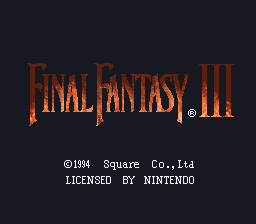
Play Final Fantasy III (USA) (Rev 1)
Game Introduction
Final Fantasy III is a role-playing game released by Square for the FC console in 1990, the third entry in the Final Fantasy series. It first introduced the job change system, letting players freely switch character jobs based on battle needs for diverse strategies. The story follows four orphans chosen by the Crystal of Light, who embark on an adventure to restore world balance. It uses a turn-based battle system, where characters gain EXP from battles to level up and unlock new jobs and skills. In 2006, a 3D remake launched on Nintendo DS with fully upgraded graphics and systems, marking the first release outside Japan. This version sold ~1.93 million copies worldwide and received widespread acclaim. Final Fantasy III is also available on multiple platforms, including iOS, Android, and PlayStation Portable, to suit different players’ needs.
Gameplay
Game Overview
This North American Final Fantasy III is in fact the Japanese Final Fantasy VI, released in Japan on April 2, 1994 and in North America that October under the III title, because Final Fantasy II, III and V had never left Japan and the numbering shifted by two. It is set in a steampunk world where the Empire builds Magitek machinery from captured Espers, an amnesiac girl named Terra falls in with the Returners resistance, and the court mage Kefka seizes the power of the Warring Triad halfway through and genuinely destroys the world. The Super Nintendo and PlayStation versions have sold 3.48 million copies combined.
Core Gameplay
Combat uses the Active Time Battle system with a party of up to four, and several set pieces split the cast into three groups you switch between. All fourteen playable characters bring a unique command: Terra's Trance, Locke's Steal, Edgar's Tools, Sabin's Blitz, Celes's Runic, Mog's Dance. Magic is not learned by levelling but by equipping Magicite, the crystallised remains of an Esper, and earning AP in battle, and the equipped Magicite also shapes stat growth on level up.
Magicite and the World of Ruin
After the world breaks apart, the game opens up: you get the airship, the fourteen characters are scattered, and you can either storm the final dungeon with three of them or hunt every companion down and play out their personal chapters. The opera house sequence, in which Celes stands in for the diva Maria, is unlike anything else on 16-bit hardware. Kefka is one of the few villains in the series who actually wins, and the second half of the game is the world he won.
Game Tips
- The North American III is the Japanese VI, because Final Fantasy II, III and V had never been released outside Japan and the numbering slipped
- Fourteen playable characters, the largest cast in the main series, each with a signature command such as Trance, Steal, Tools, Blitz, Runic, Dance or Lore
- The Magicite system: equip the crystallised remains of an Esper, then earn AP in battle to learn its spells, with the equipped Magicite also steering stat growth on level up
- Active Time Battle combat for a party of four, plus scenes that split the cast into three simultaneous groups
- The World of Ruin: once the world is shattered the second half opens up, with an airship and the option to skip most of the cast and head straight for the end
- The opera house sequence with Celes singing in Maria's place, an unusually staged set piece for 16-bit hardware
- Score by Nobuo Uematsu and an English localisation by Ted Woolsey completed in roughly thirty days
Frequently Asked Questions
It is Final Fantasy VI. Japan got it in 1994 as Final Fantasy VI, while North America received it as Final Fantasy III because the Japanese II, III and V had not been released overseas. Later PlayStation, Game Boy Advance and Pixel Remaster versions restored the VI title.
No. In the World of Ruin you can walk into the final dungeon with just three, and reuniting the cast is mostly about their personal story chapters and the equipment they bring.
Equip a piece of Magicite and you earn AP in battle towards the spells it holds, which become permanent once learned. The equipped Magicite also determines your stat bonuses on level up and can be summoned in battle.
The main story runs about thirty-five to forty hours, and closer to fifty if you complete every character chapter, hunt the optional bosses and chase the best gear.
It is the second half, after Kefka shatters the planet and the map breaks into islands. With the airship in hand you explore freely and decide which companions to bring back, an unusually open back half for a 16-bit RPG.