A Fan Rebuilt TF2's Badwater Basin Payload Inside 8-Bit Battle City — and It Runs in Your Browser
Some fan projects aim for spectacle. This one aims for a very specific overlap: people who love Team Fortress 2 and people who grew up on 8-bit tanks. Nineteen days ago, Reddit user u/Adventurous-One7430 posted on r/tf2 with a simple pitch — they had rebuilt Badwater Basin's Payload mode inside retro 8-bit Battle City, better known to much of the world as Tank 1990.
The result is a free browser game at tank.nosfir.online — no installs, no ads, no microtransactions. The creator describes it as "a retro tribute to TF2 and classic 8-bit tanks," and the design translation is smarter than the pixel count suggests. BLU team pushes the cart through four checkpoints, and the cart itself acts as a moving shield against incoming fire. RED team defends the points, eliminates attackers, and stalls until the timer runs out. It supports two players locally — two gamepads or a split keyboard — and, more impressively, two devices over local Wi-Fi or hotspot via direct peer-to-peer. A couch co-op NES homage with online-adjacent multiplayer, wrapped around one of TF2's most beloved maps.
Badwater Basin: The Map Being Honored
To appreciate the tribute, start with the original. Team Fortress 2 launched in October 2007 without Payload at all. The mode arrived in April 2008 with the Gold Rush Update — escort a bomb cart along rails, push it through checkpoints before time expires — and it immediately became one of the game's signature ways to play. Badwater Basin followed on August 19, 2008, as the centerpiece of the Heavy Update: the second Payload map ever, and the first to compress the mode into a single stage with four checkpoints.
It was a hit. The desert basin — named, like the lowest point in North America, after Death Valley's Badwater — became a permanent fixture of casual and competitive rotation alike, the kind of map TF2 players can navigate blindfolded. Nearly two decades later, someone looked at its rail line snaking through checkpoints and saw something older hiding inside it: a maze, a thing to protect, and an enemy that never stops coming.
Battle City: The Other Half of the Equation
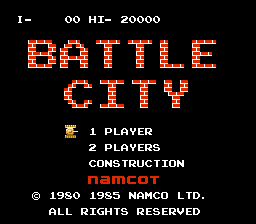
That something older has its own remarkable history. Battle City launched in Japan on September 9, 1985, Namco's Famicom successor to its 1980 arcade game Tank Battalion. The formula was elegant: defend the eagle at the bottom of a 13-by-13 maze, destroy twenty enemy tanks per stage, survive all 35 stages. Brick walls crumbled under fire, steel walls held, water blocked tanks but not shells, ice sent you sliding. Flashing tanks dropped power-ups — stars to upgrade your cannon, grenades to clear the screen, clocks to freeze the enemy.
Two things made it immortal. It shipped with simultaneous two-player co-op and a built-in level editor in 1985, years before user-made levels were an industry feature. And through an accident of history, it became one of the most widely played games on Earth: Battle City was never officially released outside Japan, but it spread across the globe on bootleg multicarts bundled with Famicom-clone consoles, usually renamed Tank 1990. For an entire generation — from Eastern Europe's Dendy machines to living rooms across Asia — that pirate version simply was video games. Both the original Battle City and the Tank 1990 translation that carried it worldwide still run in a browser today.
Why This Mashup Actually Works
Strip both games to their skeletons and the pairing stops looking random. Payload is an escort objective: a fragile thing on a fixed route, one team shepherding it forward, the other digging in to stop it. Battle City is the mirror image — a defense objective where the fragile thing sits still and you orbit around it. Both are about geometry, sightlines, and the question of how much ground you can hold before something breaks through.
The fan remake gets the details right where it counts. Making the cart a moving shield is exactly how TF2 players use it on Badwater — hugging the bomb for cover on the final push — rendered in four directions and two buttons. And building the whole thing on Battle City's grid means the tribute runs on nostalgia from both directions at once.
Play the Classics Behind It
Whether you arrive from TF2 or from 8-bit tanks, the source material is worth your time. The Namco Museum Archives edition offers another way to run Battle City in your browser, and the rest of the NES library is full of games that turned simple rules into forty-year obsessions. And if you have two devices on the same Wi-Fi, the fan remake itself is waiting at tank.nosfir.online — the cart isn't going to push itself.