Spy Hunter: The 1983 Arcade Legend That Turned a Bond Rejection into Gaming History
In January 2024, someone on r/nostalgia posted a photo of the Spy Hunter arcade cabinet with a caption that needed no explanation: "Spy Hunter 80s arcade game classic." The thread did what Spy Hunter threads always do — filled up with people humming the theme song in text form. More than forty years after release, that is still the game's entire elevator pitch: one cabinet, one steering wheel, and a tune nobody forgets.
Here is how a failed licensing deal, a designer's birthday, and the best upgrade mechanic of the early arcade era combined into one of 1983's defining machines.
The Bond Theme That Never Was
Spy Hunter shipped in November 1983 from Bally Midway, designed by George Gomez. The fantasy was explicit: a James Bond car chase, minus the license. Players got the G-6155 Interceptor — a name that looks like a spy codename but is actually Gomez's birth date — a weapons-laden supercar modeled on a Chevrolet Camaro, tearing up a vertically scrolling highway.
The soundtrack was supposed to complete the illusion. Midway wanted the James Bond theme and could not get the rights, so the team pivoted to Henry Mancini's theme from the TV series Peter Gunn. It turned into one of the great accidental wins in game audio: the jazzy, menacing bassline fit the spy fantasy so well that most players assumed it was written for the game. It was also one of the earliest uses of a licensed, pre-existing music track in a video game — years before that became standard practice.
The cabinet itself sold the fantasy before you spent a quarter: a steering yoke with triggers and thumb buttons on both grips, a two-position gear shifter, a floor pedal, and a dashboard of weapon status lights. For kids years away from a driver's license, it was the closest thing to being Bond that 1983 could offer.
The Weapons Van: Gaming's Best Drive-Through
Underneath the dressing, Spy Hunter was a survival game. Enemy cars wanted you dead: the Switchblade with tire-slashing hubcaps, the armored Road Lord, the Enforcer limousine firing from its rear window, and the Mad Bomber helicopter overhead. Civilian traffic filled the gaps — and hitting an innocent driver froze your score counter, a small moral rule in a game about highway warfare.
Your default machine guns were never enough. The real thrill was the weapons van: a truck that pulled ahead, lowered its ramp, and invited you to drive inside at full speed. Pull it off — it was genuinely hard — and you rolled out with oil slicks, smoke screens, or ground-to-air missiles. Q Branch, delivered at sixty frames per second.
Then the road would fork toward a boathouse, and the Interceptor would convert into a speedboat, trading highway for open water where the Barrel Dumper and Doctor Torpedo waited. There was no ending. The game simply escalated until it won, and players fed it quarters anyway — Spy Hunter ranked among the top five highest-grossing arcade games of both 1984 and 1985.
From Arcades to Living Rooms: A Forty-Year Afterlife
Success meant ports, and Spy Hunter went everywhere: Commodore 64, Atari 2600, ColecoVision, ZX Spectrum, and a 1987 NES version by Sunsoft that became many players' first contact with the game — including its infamously buggy collision detection, which let a pointed-straight car cruise off-road across dirt and riverbanks without consequence.
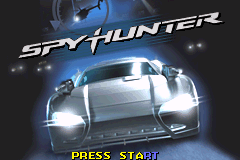
The sequels tell a stranger story. Spy Hunter II (1987) swapped the top-down view for a behind-the-car perspective nobody liked and vanished. Super Spy Hunter on NES was not a sequel at all but Sunsoft's unrelated game Battle Formula, rebranded for the West. The series went quiet until 2001, when Paradigm Entertainment rebuilt it in 3D as a mission-based action game for PS2, Xbox, GameCube, PC — and the Game Boy Advance, the handheld Spy Hunter that carried the Interceptor into pockets. Then came the strangest chapter: Spy Hunter: Nowhere to Run (2006), built around a screenplay for a Spy Hunter movie that never escaped development hell, starring Dwayne "The Rock" Johnson. A second reboot arrived in 2012 for Vita and 3DS. The film, for the record, still does not exist.
The Easter Egg Department
Few 1983 games kept surfacing in odd places as reliably as Spy Hunter. Bally turned it into a pinball machine in 1984. Microsoft hid a playable version inside the first release of Excel 2000 — a spreadsheet game so popular internally that Microsoft reportedly banned Easter eggs from its software shortly after. Decades later, the Interceptor showed up as a drivable vehicle in Lego Dimensions, and the arcade original shipped as an unlockable inside Gotham Knights. The Peter Gunn bassline outlived every platform it ever ran on.
Which brings the story back to that r/nostalgia thread. People were not reminiscing about a game they played once. They were remembering a machine that made a licensing failure feel like a signature, and a Tuesday afternoon feel like espionage.
Take the Wheel Again
The GBA generation of Spy Hunter is the easiest way back in: mission-based, land-and-sea Interceptor action that runs straight in your browser. If you want double the Midway combat driving, the Spy Hunter & Super Sprint two-pack pairs it with another arcade legend. And if this put you in a handheld mood, the rest of the GBA library is one click away — no quarters required.