Sin and Punishment: The Japan-Only N64 Game That Spoke English
In August 2024 someone walked into r/casualnintendo and called it "probably the most popular Japanese only N64 game." The thread mostly agreed, with one objection: surely Animal Crossing counts?
Buried inside the thread was a much better question than "is it popular." One commenter complained that it's hard to follow the story because "Nintendo butchered the games voiceover when they released it on Nintendo Online." Another pushed back — and u/GGXRDStriv had the correction: "the original Sin and Punishment on N64 ONLY had English voice over with Japanese subtitles, despite being a Japanese exclusive. [...] So the voice over was always 'butchered', lol. It's been like that since the beginning."
A game released in one country, in one language, recorded entirely in another. Twenty-one years later, that decision is the reason anybody outside Japan got to play it.
The wrong game at the end of the wrong console
Development started in 1997. Masato Maegawa, Treasure's president, noticed that everyone held the N64 controller by the right prongs because Super Mario 64 had made that the default — and that the left prongs were going unused. A rail shooter built around that grip became the pitch.
Production crawled. It began with what insiders described as an absolute minimum crew: two programmers and two designers. By the end, more people had worked on it than on any other Treasure product. Director Hideyuki Suganami programmed on it too; Atsutomo Nakagawa led programming, Yasushi Suzuki led character art, and both had come off Radiant Silvergun. It was the last game Suganami made before leaving Treasure. Nintendo R&D1 co-developed, and the working title was Glass Soldier.
Then it shipped on 21 November 2000, weeks before Nintendo moved on to GameCube. Roughly 100,000 copies moved. Maegawa said he couldn't call it a financial success — Nintendo had wanted the genre represented on the machine, and that was the reason it existed. Fewer than a hundred thousand copies of one of the best N64 games ever made went into circulation, which is why an import copy cost around US$100 for years afterward.
Why nobody heard the dialogue
The English voice track isn't an accident of localisation. There was no localisation.
The game was built with a North American release in mind, with an English-speaking cast recording every line. Then Treasure quietly pulled it from its Western release list, and the Japanese cartridge went out with full English voice acting and Japanese subtitles. English-speaking reviewers who imported it could follow the plot by ear and the text not at all.
Two consequences followed. First, it made the game unusually easy to import and review in the West — hence IGN calling the probability of a Virtual Console release "Very High" back when the service was announced, and hence its long run as one of the most requested titles there. Second, when the Western release finally happened, there was nothing left to dub. All that was needed were menus, which Nintendo Software Technology translated.
China got it three years before North America did
This is the part that usually gets skipped.
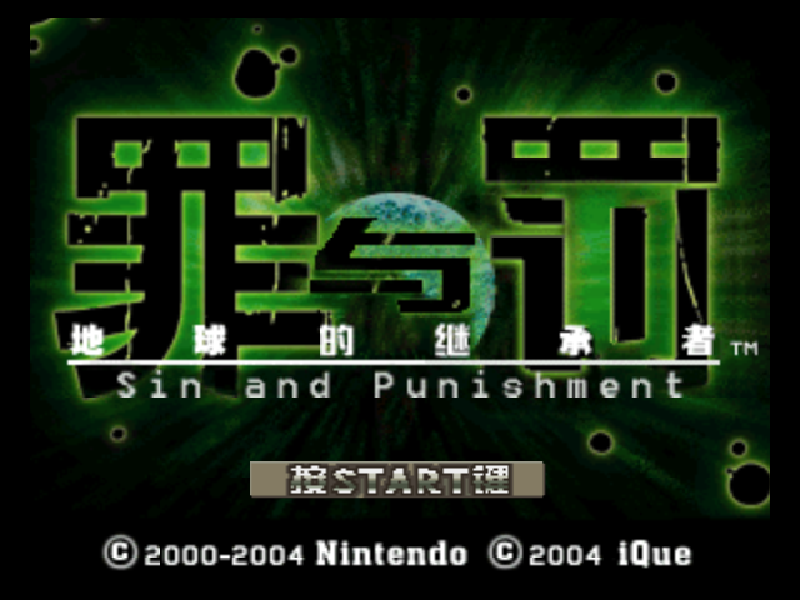
In 2004 — most sources put it in September — Sin and Punishment was released for iQue Player in China, with a full Chinese-language interface: menus, cutscenes and all. That is the only place outside Japan where you could buy it in a shop, and it beat North America's release by three years.
It is also why the Chinese audience had a legitimate, official route to the game while everyone else was paying import prices or downloading a fan translation. You can still play that release — the iQue version, with the official simplified Chinese text intact.
The company line-up was short but serious: iQue also put out official simplified Chinese versions of Super Mario 64, Paper Mario and Mario Kart 64 on the same hardware. For a Chinese N64 owner in 2004, a Treasure rail shooter sitting on the shelf next to Mario was simply part of owning the console.
Twenty-one years of drift
| Date | What happened |
|---|---|
| 21 Nov 2000 | Released on Nintendo 64, Japan only |
| 2004 | iQue Player release in China with full Chinese localisation |
| Sep–Oct 2007 | Wii Virtual Console: Japan 20 September, PAL regions 28 September, North America 1 October |
| Aug 2015 – 2016 | Wii U Virtual Console: North America 27 August 2015, PAL regions 3 September, Japan in 2016 |
| 25 Oct 2021 | Added to Nintendo Switch Online — Nintendo 64 as part of the first wave |
The Virtual Console launch is worth pausing on. Western copies cost 1,200 Wii Points, 200 more than the usual price for an N64 game, because this was the first time the menus had been translated. Nobody much complained. Seven years of asking tends to lower price sensitivity.
Then came 25 October 2021, and Sin and Punishment landed in the very first batch of N64 games added to Nintendo Switch Online. Twenty-one years after it shipped, the subscription service finally did what 1999 never got around to.
What makes it worth the wait
Forget the story. Everybody agrees the story is nonsense — deliberately so — and the writing isn't the attraction.
The design is. Progress is automatic; your job is aiming, dodging, rolling, jumping and double-jumping while the camera drags you through nine stages. Two firing modes sit behind one button: manual, with a red reticle, which does real damage; and lock-on, with a purple one, which sticks to enemies so you can concentrate on not dying. Getting near an enemy switches your gun into a beam sword that does dramatically more damage than bullets — and reflects certain projectiles straight back. A timer runs down across every stage, and when it hits zero your health starts bleeding until you find another pickup.
It's often compared to Star Fox 64, the other great N64 shooter you can still play with official Chinese text, and the divergence is instructive. Star Fox puts you in a vehicle and asks you to fly it. Sin and Punishment puts you on foot, separates aiming from movement entirely, and hands you a sword for anything that gets too close. Treasure took the same "move through space while shooting things" framework and made every input a separate decision.
Two people can also share one character: one handles movement, the other handles the reticle. It's the best local co-op idea Treasure ever shipped and nobody ever talks about it.
Reviewers recognised what it was immediately. Famitsu gave it 35/40 at launch; IGN handed the Virtual Console release a 9.0; GameRankings settled around 86%. Every single one of those reviews made the same complaint: it's about two to three hours long. In 2000, on a console that was dying, on a cartridge costing import money, a two-hour game didn't stand a chance. In 2021, on a subscription service, a two-hour game with that much density is almost ideal.
Why people are playing it now
The 2024 thread reads the way those threads always do once a game gets re-released: a wave of people discovering it late, and one strong consensus about what to play next. As u/KongaCast put it: "Really fantastic and a game more people should try out. Story is ridiculous in a good way with how over the top it is, and gameplay is some of the best on rail shooting I've played. Sequel on the Wii is even better."
The sequel he means is Sin & Punishment: Star Successor, released for Wii in 2009 — this time worldwide, this time on a platform that sold. Whether it beats the original is still argued. Either way, the N64 game is the one that took twenty-one years, a fan petition and three re-release windows to reach the people it had already been recorded in English for.
The Nintendo 64 library is full of games that missed their window. Few missed it this narrowly, and fewer still were this ready for everyone else.