Wave Race 64 at 30: From 1996 Water Physics Legend to Native PC Remaster
A thread on r/n64 has been passing around screenshots of Wave Race 64 running with brand-new textures — sharper HUD text, redrawn rider portraits, jet skis that don't dissolve into mush when you get close. It looks like a remaster. It isn't one, and that's the interesting part: nobody at Nintendo made this, and no emulator is involved either.
Thirty years after release, a 1996 jet ski racer is running as a native PC program. Here's how that happened, and why this particular game keeps attracting that kind of effort.
The Game That Made Water the Whole Point
Wave Race 64 came from Nintendo EAD and arrived on 27 September 1996 in Japan, followed by a North American release in November 1996 and a European one in April 1997. It was the sequel to the 1992 Game Boy Wave Race, but it had almost nothing in common with it beyond the name.
The hook was the water. Not a texture slapped over a flat plane — actual waves that changed how your jet ski behaved. Lean into a swell and you'd launch; hit a trough at the wrong angle and you'd lose speed and grip. Courses had weather variations, and the surface responded differently as conditions changed.
The other half of the design was the buoy slalom. You have to pass each buoy on an alternating side — left, then right, then left. Thread them correctly in a row and you build a power boost; miss one and your ski gets powered down, which is a brutal penalty in a race decided by tenths. Points came from finishing position (7 for first, 4 for second, 2 for third, 1 for fourth, zero if you're disqualified), and falling short of the required total between races meant game over.
Four riders, each with real stat differences: Ryota Hayami as the all-rounder, Ayumi Stewart with the best acceleration and handling but the lowest top speed, Miles Jeter with the sharpest handling and the worst grip, and Dave Mariner with the highest top speed and the worst handling. On top of that, three tuning sliders — handling, engine, and grip — let you push the ski toward acceleration or top end.
Beyond Championship (six courses on Normal, seven on Hard, eight on Expert), there was Time Trial, a Stunt Mode scored off ramps and rings, and split-screen two-player. The Japanese version carried Kawasaki Jet Ski branding and Fanta Orange ads; international releases dropped the Fanta. A 1997 Shindō Pak Taiō re-release in Japan added Rumble Pak support and Time Trial ghosts. The series continued with Wave Race: Blue Storm on GameCube in 2001.
Why Nobody Ported It
For most of the last three decades, Wave Race 64 was stuck on the console it shipped for. The official re-releases — Wii Virtual Console in 2007, Wii U later, Nintendo Switch Online in 2022 — were all emulated or simulated versions of the same N64 build. There was never a PC release, and the game's whole identity was tied to hardware behaviour that emulators historically fumbled: water that moves, water that reacts, water at a stable frame rate.
That's the gap the recompilation projects walked into.
What "Recomp" Actually Means Here
Wave Race 64: Recompiled isn't emulation in the usual sense. The toolchain — N64Recomp — takes the game's original MIPS machine code and statically translates it into C, which is then compiled as a native Windows or Apple Silicon binary. It runs on N64ModernRuntime, draws through RT64, and uses RecompFrontend for menus and controller support.
Two consequences follow from that approach, and both matter:
The game's logic is untouched. Racing still updates at 30 Hz, menus and Time Trial at 20 Hz, exactly as Nintendo shipped it. Physics, camera behaviour, and race timers are unchanged. RT64 then interpolates movement between those updates so motion matches your display's refresh rate. It looks smoother; it does not play differently.
No assets are included. You supply your own ROM dump, and the launcher reads from it every time it runs. Which is also the project's biggest practical catch: it only accepts Wave Race 64 (USA) (Rev A), also labelled v1.1, with SHA-1 508dfc2d4caa42b6f6de5263d0aed5e44ac7966a. Japanese, European, original v1.0, and Shindō dumps don't work, because every code patch in the build is tied to that one revision's addresses.
What the Remaster Adds
Once the game is C code on a modern renderer, the upgrades are straightforward:
- HD textures. 1,828 mappings across 1,806 images by Brian Tate, covering HUD fonts, the Wave Race logo, buoys, rider portraits, island surfaces, ramp planks, and ski panels. Original textures remain selectable.
- Water modes. A new default Aqua preset with brightness, tint, and clarity sliders, plus High (screen-space reflections, finer spray) and Modern options, and adjustable ripple strength and airborne spray. F9 and F10 toggle between Aqua and Classic for side-by-side comparison.
- Presentation. Widescreen and ultrawide with configurable HUD placement, field of view adjustable from 45 to 110 without stretching geometry, increased draw distance so far buoys stop popping in, and MSAA and downsampling options on supported hardware.
- Audio. Nine replacement music recordings, switchable against the original soundtrack in the menu. Sound effects and race commentary stay original.
- Haptics. Event-based controller vibration for landings, crashes, buoys, power-ups, countdowns, lap times, and the finish line, with an intensity slider or full disable.
It's still flagged as beta. Stunt Mode and parts of the championship celebration have seen much less testing than the main circuits, and certain Mac configurations don't get the locked 120 Hz refresh the project tested against.
The Part People Argue About
The upstream project's own credit line is unusual for a fan port: it states that the original version was written by Claude, Anthropic's AI model, working in Claude Code under the direction of Daniel Gomes Vieira, who set the goals, made the decisions, played the builds, and reported what he saw. The fork most people download is elliotttate's, which bundles the HD textures and music. A separate project, RaceWave46 by DomazinUS, marks the game's 30 years with ray-traced water reflections and shadows.
The reaction splits predictably: genuine excitement that a hard-to-preserve game finally runs well on modern hardware, mixed with unease about an AI-authored codebase and how credit should work. Both reactions are reasonable. What's hard to argue with is the outcome — a game Nintendo hasn't touched in decades now boots on a PC in widescreen.
Race It in a Browser Instead
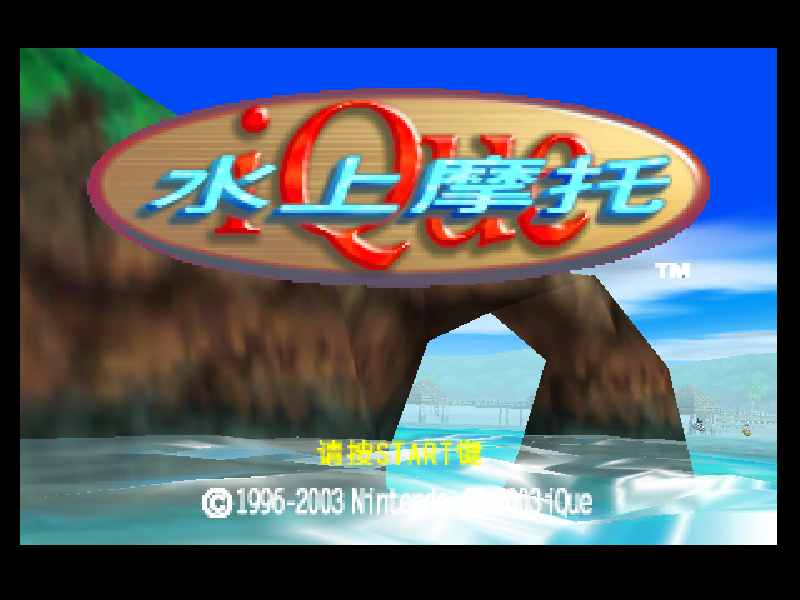
You don't need a ROM dump or a Rev A cartridge to find out what the fuss was about. Wave Race 64 is playable right now in an official Simplified Chinese version, with the buoy slalom, the four riders, and that 1996 water intact.
If the era appeals more than the waves, the N64 had no shortage of racers — Mario Kart 64 and Excitebike 64 both came out of the same window. Browse the full N64 library and start one in your browser — no downloads, no setup.