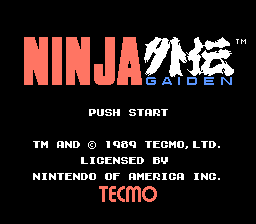
Play Ninja Gaiden (USA)
Game Introduction
Ninja Gaiden (Japanese: Ninja Ryūkenden) is a side-scrolling action platform game developed and published by Tecmo in 1988. It first launched in Japan for the Famicom on December 9, 1988, then released in North America in March 1989 and Europe on August 15, 1991. The protagonist is Ryu Hayabusa, a young ninja of the Hayabusa clan. When his father Joe Hayabusa mysteriously disappears, Ryu’s only clue is a letter stating Joe has fallen in battle if he does not return. Carrying his family’s Dragon Sword, Ryu travels to the U.S. to find archaeologist Walter Smith. Along the way, he is attacked and knocked unconscious by a mysterious woman, waking to find he has been entrusted with a mysterious statue. After meeting Smith, Ryu learns that his father and Smith once discovered two statues sealing an evil deity in South America, each keeping one to prevent the deity’s resurrection. However, evil forces steal the statues and kill Smith. CIA agent Foster contacts Ryu, asking for help to recover the statues. The woman who attacked Ryu is actually Foster’s subordinate, a spy undercover under the evil demon king Jashin. Ryu infiltrates Jashin’s lair, rescues his brainwashed father Joe, and defeats Jashin. Yet the evil deity still resurrects during a lunar eclipse. After a fierce battle, Ryu destroys the deity and leaves with Irene, who refuses to follow Foster’s orders anymore. Ninja Gaiden is known for its high difficulty and innovative cutscene-driven storytelling. Its challenge comes from precisely placed enemies and level traps, requiring intense focus and precise controls. The use of cutscenes was unprecedented in action games at the time, adding rich narrative depth. The game’s success spawned sequels and ports across multiple platforms, including the PC Engine, Super Nintendo, and Virtual Console.
Gameplay
Game Overview
Tecmo released Ninja Ryuukenden for the Famicom in Japan on December 9, 1988, and shipped it to North America as Ninja Gaiden in March 1989. Ryu Hayabusa carries his clan's Dragon Sword to America to find out what happened to his missing father, and ends up fighting his way into the stronghold of the man behind it all. What people actually remember it for is the presentation: long anime-style cutscenes with dialogue play between stages, which almost no side-scrolling action game was attempting on the NES at the time.
Core Gameplay
The campaign is built from six Acts and twenty stages, and every Act closes with a fight against one of the Malice Four. The Dragon Sword handles close-range work, while secondary weapons draw from a spiritual strength meter: the shuriken, the windmill throwing star that comes back like a boomerang, the upward-angled fire wheel, the downward-angled fire dragon, and a mid-air jump and slash. Red lanterns refill the meter completely, blue ones add ten points, and hourglasses freeze every enemy and projectile on screen for five seconds. Ryu can also cling to walls and ladders, though he cannot swing his sword while hanging.
Advanced Techniques
While hanging on a wall, press the direction away from it plus jump to kick off - that is the only way across several of the wider gaps. Hold jump and alternate left and right to spring back and forth between two walls and climb; a good number of hidden items sit on that route. The windmill throwing star keeps flying after it returns to Ryu, so jumping over it lets you hold one alive on screen for sustained damage at a tiny meter cost. The invincible fire wheel gives roughly four seconds of invulnerability, but it shuts off the moment Ryu touches a boss and is cancelled the instant he picks up another ninja art.
Game Tips
- Six Acts and twenty stages, each Act ending with a boss from the Malice Four
- Wall clinging and wall-spring jumps: alternate left and right to zigzag up a shaft
- Five ninja arts share one spiritual strength meter: shuriken, windmill star, fire wheel, fire dragon, jump and slash
- Anime-style cutscenes with dialogue between stages, a storytelling experiment for 1989
- Hourglasses freeze every enemy and projectile on screen for five seconds
- Soundtrack by Keiji Yamagishi and Ryuichi Nitta, one of the most recognisable NES scores
- Unlimited continues, but dying on stage 6-4 or 6-5 sends you back to the start of Act 6
Frequently Asked Questions
The stages themselves are short - a practiced player finishes a run in around half an hour. First-timers usually need several hours, because the platforming from Act 5 onward and the birds that knock you into pits are where runs die.
Neither. The NES version relies on unlimited continues: you restart from the beginning of the stage you died on. The only harsher rule is that dying on 6-4 or 6-5 sends you back to 6-1.
The script and some cutscene details differ from the Japanese Ninja Ryuukenden, but the level layouts and difficulty are essentially the same. The European release was retitled Shadow Warriors.
Yes. Enemy spawns are hand-placed and timed to catch you mid-jump, and the stage timer leaves very little room for hesitation. Learning the wall-spring climb and the windmill throwing star makes a huge difference.
No, the game is single-player from start to finish.